
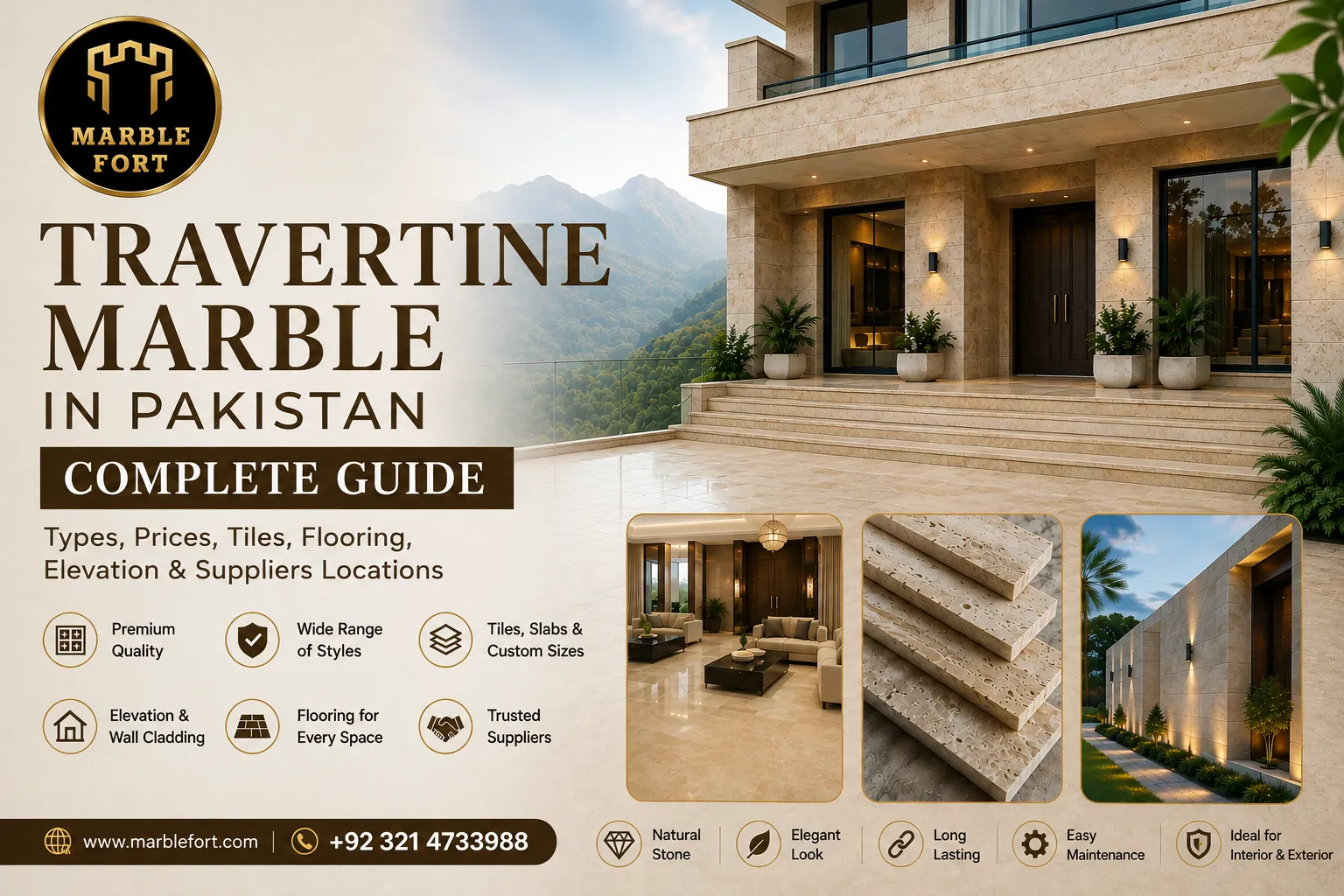
Travertine marble is becoming an increasingly popular natural stone choice in Pakistan for residential, commercial, architectural, and landscaping projects. Its natural texture, warm earthy colors, distinctive patterns, and timeless appearance make it suitable for everything from luxury house flooring and front elevations to wall cladding, bathrooms, staircases, patios, villas, and commercial interiors.
Unlike manufactured surfaces that are designed to look identical from one piece to another, natural travertine has its own character. Variations in color, grain, cavities, texture, and veining are part of the stone's natural formation. These characteristics give every installation a unique appearance.
Whether you are planning a modern house in Lahore, a luxury villa in Islamabad, a commercial project in Sialkot, a residential development in Multan, or an architectural project anywhere in Pakistan, choosing the right travertine requires an understanding of its types, applications, finishes, prices, installation requirements, and maintenance.
This comprehensive guide covers everything you need to know about travertine marble in Pakistan, including travertine types, colors, slabs, tiles, flooring, wall cladding, front elevations, prices, applications, installation, polishing, cleaning, sealing, advantages, disadvantages, and how to choose a reliable travertine supplier.
What Is Travertine Marble?
Travertine is a natural stone formed primarily through mineral deposits around hot springs, mineral springs, and other geological environments. It is technically a form of limestone and is composed largely of calcium carbonate.
The term "travertine marble" is commonly used in the Pakistani natural-stone market to describe travertine products, although from a geological perspective travertine and marble are different types of natural stone.
Travertine is recognized by its characteristic porous texture, natural cavities, layered structure, earthy tones, and organic patterns.
Depending on the variety and processing method, travertine can have appearances ranging from light cream and beige to silver, grey, brown, reddish, and other natural shades.
Its ability to combine natural character with architectural elegance has made it a popular material for:
- Flooring
- Wall cladding
- Exterior façades
- Front elevations
- Staircases
- Bathrooms
- Kitchens
- Vanity areas
- Fireplaces
- Columns
- Pillars
- Patios
- Pool surroundings
- Outdoor spaces
- Luxury villas
- Commercial interiors
Because it is a natural material, every batch can contain variations. For large projects, it is therefore important to inspect representative slabs or samples before finalizing the material.
What Is Travertine Stone?
Travertine stone is a naturally occurring limestone-based material that develops through mineral deposition. Over geological time, these deposits form layers and textures that become visible when the stone is cut and finished.
One of the defining characteristics of travertine stone is its natural porosity. Small holes, cavities, and variations in texture can occur naturally within the material.
These characteristics are sometimes filled during processing, while other finishes may preserve more of the natural texture.
The final appearance of travertine depends on several factors, including:
- Geological origin
- Natural mineral composition
- Color
- Density
- Porosity
- Cutting direction
- Surface treatment
- Filling
- Honing
- Polishing
- Brushing
- Tumbled finishing
This is why two travertine products with similar names can still have noticeably different appearances.
Travertine vs Marble
Travertine and marble are both natural stones, but they are not the same material.
Marble is a metamorphic stone formed when limestone undergoes heat and pressure over geological time. It is often recognized for its elegant veining, crystalline appearance, and ability to achieve a high polish.
Travertine, in contrast, is a sedimentary limestone formed primarily through mineral deposits. Its natural appearance is generally more porous and textured.
Appearance
Marble often provides a polished and luxurious appearance with prominent veining.
Travertine generally provides a warmer, more organic appearance with natural pores, cavities, and earthy patterns.
Texture
Travertine tends to have a more visibly natural and textured surface, depending on the finish.
Marble can provide a smoother and more refined surface, particularly when polished.
Design Style
Marble is frequently used for luxury interiors, elegant floors, countertops, feature walls, and decorative applications.
Travertine works especially well in natural, Mediterranean, contemporary, rustic, traditional, and architectural designs.
Which Is Better?
There is no universal answer.
The better material depends on the project's:
- Location
- Application
- Design
- Budget
- Maintenance requirements
- Desired appearance
- Traffic level
- Installation requirements
Travertine may be preferable when the goal is a warm, natural, textured appearance, while marble may be preferable when a highly polished, elegant appearance is desired.
Travertine vs Granite
Travertine and granite are also different natural stones with different characteristics.
Granite is an igneous rock known for its hardness and durability. It is commonly used in high-use areas, kitchen countertops, commercial applications, flooring, and exterior projects.
Travertine is softer and more porous than granite and is valued more strongly for its natural texture and architectural appearance.
Granite
Granite is generally selected for:
- Kitchen countertops
- High-use surfaces
- Commercial applications
- Heavy-traffic areas
- Exterior applications
- Durable worktops
Travertine
Travertine is commonly selected for:
- Flooring
- Wall cladding
- Feature walls
- Front elevations
- Bathrooms
- Staircases
- Patios
- Villas
- Architectural surfaces
The decision should always be based on the specific application rather than simply comparing the stones by name.
Types of Travertine
Travertine is available in many visual variations. Names may differ depending on suppliers, markets, origins, and commercial classifications.
Some commonly searched travertine categories in Pakistan include beige, Roman, silver, grey, red, and natural travertine.
Beige Travertine
Beige travertine Pakistan is one of the most versatile options for residential and commercial projects.
Its warm neutral tone works well with:
- White interiors
- Wooden furniture
- Black accents
- Metallic finishes
- Glass
- Neutral paint
- Green landscaping
- Contemporary architecture
Beige travertine marble can be used for flooring, walls, stairs, bathrooms, façades, patios, and decorative architectural surfaces.
The major advantage of beige travertine is its ability to provide a natural appearance without dominating the entire design.
It can be used in both modern and traditional projects.
Roman Travertine
Roman travertine is associated with the classic architectural appearance of travertine traditionally seen in European and Mediterranean architecture.
Roman travertine Pakistan is often considered for projects where designers want a timeless and sophisticated natural-stone appearance.
It can be used for:
- Villa exteriors
- Flooring
- Feature walls
- Columns
- Pillars
- Staircases
- Exterior façades
- Decorative architectural details
Roman-style travertine can work particularly well with arches, columns, neutral plaster, natural wood, and classical architectural elements.
Silver Travertine
Silver travertine marble is known for its cooler grey and silver tones.
Compared with warm beige travertine, silver varieties can create a more contemporary appearance.
Silver travertine Pakistan can be considered for:
- Modern flooring
- Feature walls
- Bathrooms
- Contemporary façades
- Commercial interiors
- Luxury villas
- Outdoor applications
Silver travertine marble Pakistan can also be combined with black, white, charcoal, wood, and metallic finishes.
For modern architecture, silver travertine can create a sophisticated contrast against dark frames and minimalist design elements.
Grey Travertine
Grey travertine has become increasingly relevant for contemporary architectural projects.
Grey travertine Pakistan can be used where designers want a natural stone with cooler undertones.
Grey travertine marble Pakistan may work particularly well with:
- Black aluminum
- Glass
- Concrete
- White walls
- Dark wood
- Modern lighting
- Minimalist interiors
Grey travertine tiles Pakistan can also be considered for floors and feature walls where a modern natural-stone appearance is desired.
Red Travertine
Red travertine marble provides a stronger and more distinctive appearance than neutral travertine varieties.
Its natural reddish tones can be used as an accent material or for architectural features where a dramatic appearance is desired.
Because stronger colors can have a significant impact on the overall design, red travertine should be selected according to the project's architecture, lighting, furniture, and surrounding materials.
Natural Travertine
Natural travertine Pakistan is valued for its authentic appearance and organic characteristics.
Natural travertine can contain:
- Small cavities
- Veins
- Mineral deposits
- Color variation
- Grain variation
- Layered patterns
- Natural surface texture
These characteristics are part of the material's natural identity.
For customers who prefer a highly uniform surface, a processed or filled finish may be more appropriate. For customers who want a more authentic natural-stone appearance, visible texture and variation may be desirable.
The important consideration is that the selected material should be appropriate for the intended application.
Travertine Colors and Textures
Travertine colors can range from very light cream and ivory to beige, brown, silver, grey, and reddish tones.
Color is one of the first things buyers should consider because it affects the entire visual character of a space.
Warm Colors
Beige, cream, ivory, and brown travertine can create a warm and inviting atmosphere.
Cool Colors
Silver and grey travertine can complement contemporary and minimalist architecture.
Stronger Colors
Red and deeper-toned varieties can be used as accent materials.
Texture is equally important.
A smooth polished surface creates a different appearance from a honed, brushed, tumbled, or naturally textured surface.
Travertine Slabs in Pakistan
Travertine slabs Pakistan are particularly useful for large-scale architectural and interior applications.
Large slabs allow the natural movement and pattern of the stone to become more visible across a wider surface.
Travertine slabs may be considered for:
- Feature walls
- Reception areas
- Vanity tops
- Decorative surfaces
- Large interior walls
- Commercial interiors
- Architectural applications
When buying slabs, it is important to inspect the actual material whenever possible.
The customer should consider:
- Slab dimensions
- Thickness
- Surface finish
- Natural variation
- Veining
- Cavities
- Color
- Quantity
- Cutting requirements
- Installation method
For large projects, slabs should ideally be selected together so the overall visual flow can be planned.
Travertine Tiles in Pakistan
Travertine tiles Pakistan provide a practical way to use natural stone in manageable formats.
Tiles are commonly considered for:
- Floor areas
- Walls
- Bathrooms
- Kitchens
- Hallways
- Bedrooms
- Entrances
- Patios
- Commercial interiors
Tile size can influence the final appearance of the project.
Large-format tiles can create a clean and contemporary appearance, while smaller tiles may create a more traditional or patterned effect.
The appropriate tile size should be selected according to room dimensions, layout, installation requirements, and design objectives.
Travertine Flooring in Pakistan
Travertine flooring Pakistan is one of the most popular applications for this natural stone.
Travertine can give floors a warm, natural, and premium appearance.
It can be used in:
- Living rooms
- Dining areas
- Entrance halls
- Bedrooms
- Villas
- Luxury homes
- Hotels
- Restaurants
- Offices
- Commercial buildings
The final performance of a travertine floor depends on material selection, thickness, finish, substrate preparation, installation quality, and maintenance.
For high-traffic areas, buyers should select material and finishing suitable for the expected level of use.
Travertine Marble Floor Design
Travertine marble floor design can range from simple modern layouts to more elaborate patterns.
Popular design approaches include:
- Large-format layouts
- Straight patterns
- Offset patterns
- Border designs
- Mixed-size layouts
- Contrasting stone borders
- Neutral monochromatic designs
The natural movement of travertine can itself become part of the design.
For a modern home, a large-format neutral travertine floor may provide a clean visual appearance.
For a more traditional property, a combination of borders and natural stone patterns can create a more decorative look.
Travertine Floor Tiles
Travertine floor tiles can be selected according to the space, traffic level, finish, color, and design.
For residential flooring, warm beige and cream tones can create an inviting appearance.
For contemporary interiors, silver and grey travertine may provide a more modern aesthetic.
For commercial projects, material selection should take expected foot traffic and maintenance requirements into consideration.
Travertine Wall Cladding in Pakistan
Travertine wall cladding Pakistan is an effective way to introduce natural texture into architecture.
Wall cladding can be used on:
- Interior feature walls
- Exterior walls
- Building façades
- TV walls
- Fireplace walls
- Reception areas
- Hotel lobbies
- Restaurant interiors
- Entrance walls
Travertine marble wall cladding can provide depth and visual interest while maintaining a natural architectural character.
The installation system should be selected according to whether the application is interior or exterior and according to the weight, dimensions, substrate, and environmental conditions.
Travertine Exterior Wall Cladding
Travertine exterior wall cladding can be used to create a premium natural-stone appearance on building exteriors.
It can be incorporated into:
- Front elevations
- Entrance features
- Boundary walls
- Villa façades
- Commercial buildings
- Outdoor architectural elements
Exterior applications require careful attention to anchoring, substrate preparation, moisture management, drainage, weather exposure, and installation methods.
Not every travertine product is automatically suitable for every exterior environment.
Travertine Facade Cladding
Travertine facade cladding can transform a plain building exterior into a more visually distinctive architectural surface.
The natural color variation of the stone can create depth across large façades.
Designers can combine travertine with:
- Glass
- Metal
- Concrete
- Wood
- Plaster
- Brick
- Landscaping
A façade can use travertine as the primary material or as an accent around entrances, windows, balconies, and architectural features.
Travertine Marble Front Elevation
The front elevation is one of the most visible parts of a house, which is why natural stone is frequently considered for this area.
Travertine marble front elevation designs can range from completely clad façades to selective accent areas.
Travertine can be used around:
- Main entrances
- Windows
- Garage entrances
- Columns
- Balcony walls
- Boundary walls
- Vertical architectural elements
A successful front elevation does not necessarily require covering every surface with stone.
In many modern designs, travertine works better when combined strategically with paint, concrete, glass, metal, or wood.
Travertine Marble Elevation Designs in Pakistan
Travertine marble elevation Pakistan projects can follow a variety of architectural styles.
Modern Elevation
Modern elevations often use clean lines, large windows, simple geometry, and limited material palettes.
Silver or grey travertine can work well in these designs.
Contemporary Luxury Elevation
A luxury design may combine beige travertine with glass, dark frames, warm lighting, and landscaping.
Classic Elevation
Roman travertine can complement classical features such as columns, arches, and decorative details.
Minimalist Elevation
A small amount of travertine can be used as an accent against plain walls.
The key is balance.
Travertine House Front Elevation
Travertine house front elevation designs are particularly popular for homeowners looking to create a premium exterior.
The stone can be used:
- Around the main door
- On entrance walls
- Around windows
- On columns
- On balconies
- Along boundary walls
- On selected feature sections
Using the same travertine in several carefully selected areas can create visual continuity.
However, overusing different colors and patterns can make the elevation look visually crowded.
Travertine Elevation Tiles Pakistan
Travertine elevation tiles Pakistan are another option for exterior architectural surfaces.
When selecting tiles for elevation, consider:
- Thickness
- Weight
- Fixing method
- Weather exposure
- Surface finish
- Tile dimensions
- Substrate
- Drainage
- Expansion and movement
For larger or more complex elevations, professional architectural and installation advice is recommended.
Travertine Marble Exterior Pakistan
Travertine marble exterior Pakistan projects can benefit from the material's natural appearance.
Exterior applications may include:
- House façades
- Villas
- Commercial buildings
- Entrance features
- Boundary walls
- Garden structures
- Outdoor seating areas
The selected stone should be appropriate for the specific environmental conditions and installation system.
Travertine for Houses and Villas
Travertine can be incorporated throughout a residential property.
For a luxury house, it may be used for:
- Entrance flooring
- Living room floors
- Staircases
- Feature walls
- Bathroom surfaces
- Exterior walls
- Front elevation
- Outdoor patios
- Garden paths
For villas, designers can combine travertine with landscaping to create a natural transition between indoor and outdoor areas.
Travertine for Luxury Houses
Travertine for luxury house projects is often selected because natural stone adds visual depth and a premium architectural character.
A luxury home does not necessarily need travertine everywhere.
Strategic applications can create a more sophisticated result.
For example:
- Travertine entrance
- Travertine staircase
- Feature wall
- Selective exterior cladding
- Premium bathroom surfaces
- Outdoor terrace
Combining stone with wood, glass, lighting, and greenery can create a balanced luxury aesthetic.
Travertine for Interior Projects
Travertine for interior Pakistan projects can be used in many different spaces.
Living Rooms
Travertine flooring can create a warm foundation for furniture and interior decoration.
Dining Rooms
Natural stone flooring can complement wooden dining furniture and modern lighting.
Bedrooms
Neutral travertine can create a calm and natural environment.
Feature Walls
Travertine walls can provide texture without requiring elaborate decoration.
Entrances
An entrance clad or floored with travertine can immediately establish a premium architectural impression.
Travertine for Exterior Projects
Travertine for exterior Pakistan projects can be used for both residential and commercial architecture.
Exterior uses include:
- Front elevations
- Façades
- Patios
- Garden pathways
- Outdoor seating
- Boundary walls
- Entrance areas
- Pool surroundings
The stone should be selected and installed according to the environmental conditions and intended application.
Travertine Bathroom Pakistan
Travertine can give a bathroom a natural spa-inspired appearance.
It can be used for:
- Bathroom floors
- Shower walls
- Vanity walls
- Feature walls
- Backsplashes
- Decorative surfaces
Bathrooms require careful material selection because the environment is exposed to moisture.
Proper waterproofing, drainage, installation, cleaning, and appropriate sealing are important.
Travertine Kitchen Pakistan
Travertine can be incorporated into kitchens as a flooring or wall material.
It can be used for:
- Kitchen floors
- Backsplashes
- Feature walls
- Decorative surfaces
For kitchen countertops, the suitability of travertine should be evaluated carefully based on the specific product, finish, expected use, and maintenance requirements.
For high-use work surfaces, other natural stones may sometimes be more appropriate.
Travertine Countertops Pakistan
Travertine countertops can provide a distinctive natural appearance, but they require more consideration than many other countertop materials.
Travertine is porous and relatively softer than granite, so users should understand the maintenance requirements before choosing it for a heavily used work surface.
It may be better suited to certain vanity, decorative, or lower-impact applications depending on the material and finish.
Travertine Vanity Pakistan
Travertine vanity surfaces can create a warm and luxurious bathroom aesthetic.
A travertine vanity can be paired with:
- White ceramic
- Matte black fixtures
- Brushed brass
- Wooden cabinetry
- Glass
- Neutral walls
The natural texture of the stone can become the main decorative feature.
Travertine Stairs and Staircases
Travertine stairs Pakistan projects can include both indoor and outdoor staircases.
Travertine staircase designs may use the stone for:
- Treads
- Risers
- Landings
- Side walls
- Stair feature areas
The finish should be selected carefully because stairs require appropriate slip considerations.
Edge profiles and installation details should also be planned before fabrication.
Travertine Columns and Pillars
Travertine can be used to create architectural columns and pillars for villas, entrances, commercial buildings, and classical-style homes.
Roman travertine is particularly suitable for designs inspired by classical architecture.
Columns can also be combined with plain walls and modern materials to create a contemporary interpretation of traditional architecture.
Travertine Fireplace
Travertine fireplace Pakistan designs can provide a warm architectural focal point.
The stone can be used around a fireplace as a decorative surround, provided that the selected product and installation system are appropriate for the heat exposure.
Natural stone fireplaces can work well with:
- Wood
- Metal
- Glass
- Neutral walls
- Traditional interiors
- Modern interiors
Travertine Outdoor Tiles Pakistan
Travertine outdoor tiles Pakistan projects may include patios, courtyards, garden paths, terraces, and outdoor seating areas.
Outdoor applications require additional consideration of:
- Weather
- Moisture
- Drainage
- Surface texture
- Slip resistance
- Temperature variation
- Installation
The correct finish is especially important in areas that may become wet.
Travertine Patio Pakistan
Travertine patio Pakistan projects can create a natural transition between indoor and outdoor living spaces.
A patio can combine travertine with:
- Green landscaping
- Wooden furniture
- Outdoor lighting
- Plants
- Water features
- Natural walls
The earthy appearance of travertine works particularly well with gardens and outdoor environments.
Travertine Pool Tiles Pakistan
Travertine pool tiles Pakistan projects require careful selection because pool areas are regularly exposed to water.
For pool surrounds and wet environments, the surface finish and slip characteristics should be evaluated carefully.
Proper drainage and installation are equally important.
Travertine can create a natural resort-style appearance around pools when the right material and finish are selected.
Travertine Marble Price in Pakistan
One of the most important commercial searches is travertine marble price in Pakistan.
However, there is no single fixed price that applies to every travertine product.
The price can vary according to:
- Type
- Origin
- Quality
- Color
- Thickness
- Finish
- Size
- Availability
- Quantity
- Processing
- Fabrication
- Transportation
- Installation requirements
| Format | Typical Price Range (PKR/sq ft) |
|---|---|
| Standard Size Tiles | Rs. 170 – Rs. 350 |
| Slabs | Rs. 750 – Rs. 3,000 |
| Overall Range (Local to Imported) | Rs. 170 – Rs. 3,000 |
A customer looking for an exact travertine marble rate should provide the supplier with the required specifications.
Travertine Price in Lahore
The travertine price in Lahore can vary depending on the material being sourced, the supplier, quantity, specifications, and delivery requirements.
Customers comparing prices should avoid comparing different types of travertine simply by square-foot price.
A higher-quality slab with a particular finish and thickness is not directly comparable with a lower-grade tile.
The correct approach is to compare like-for-like material.
Travertine Price Islamabad
The travertine price Islamabad market can similarly vary depending on product specifications and supply conditions.
For projects in Islamabad and Rawalpindi, customers should consider both material cost and delivery logistics.
Large quantities may require specialized transportation depending on slab dimensions and project requirements.
Travertine Marble Price Per Square Foot Pakistan
Travertine marble price per sq ft Pakistan is affected by the same factors that influence the overall cost of natural stone.
These include:
Material
Different varieties have different market values.
Thickness
Thicker material may require more stone and processing.
Finish
Polished, honed, brushed, filled, and other finishes can involve different processing requirements.
Size
Large slabs and custom dimensions can affect the overall price.
Quantity
Commercial quantities may be priced differently from small orders.
Processing
Cutting, edge work, polishing, and fabrication can add to the project cost.
Transportation
Delivery to cities outside the supplier's primary market can increase total project cost.
Travertine Tiles Price in Pakistan
The travertine tiles price Pakistan market includes a broad range of materials.
Price depends on:
- Tile size
- Thickness
- Type
- Color
- Grade
- Finish
- Quantity
- Processing
- Availability
Buyers should also remember that tile price is only one part of the final flooring cost.
The total project may include:
- Adhesive or installation material
- Cutting
- Wastage
- Labour
- Sealing
- Transportation
- Finishing
Travertine Slab Price Pakistan
Travertine slab price Pakistan can vary significantly based on slab size, thickness, color, quality, finish, and origin.
Large slabs should ideally be inspected before purchase because natural variation can be substantial.
For premium projects, customers should evaluate the complete slab rather than selecting only from a small photograph or sample.
Beige Travertine Price Pakistan
The beige travertine price Pakistan market depends on the specific variety, quality, thickness, finish, and availability.
Because beige is a popular neutral option, it is commonly considered for residential flooring, walls, stairs, villas, and architectural projects.
The best way to compare beige travertine is to request comparable samples with the same specifications.
Silver Travertine Price Pakistan
Silver travertine price Pakistan can vary depending on quality, finish, slab or tile format, thickness, and availability.
Silver travertine may command different pricing from beige or other varieties because color, pattern, and supply conditions can differ.
For contemporary projects, its cooler tones can make it particularly attractive.
Imported Travertine Price Pakistan
Imported travertine may have additional cost factors compared with locally sourced or readily available materials.
These may include:
- International transportation
- Import-related costs
- Handling
- Customs-related charges
- Exchange-rate changes
- Availability
- Local distribution
- Processing
Therefore, imported travertine price Pakistan should always be evaluated based on the delivered material rather than simply the base material price.
Natural Travertine Price Pakistan
The natural travertine price Pakistan market varies according to the specific material.
Natural variation is not necessarily an indication of low quality. In fact, many designers intentionally select travertine because of its natural character.
The important consideration is whether the natural characteristics are suitable for the intended application.
Travertine Marble Rates in Pakistan
Customers often search for travertine marble rates Pakistan when planning a construction or renovation project.
Instead of relying on a generic rate, it is better to obtain a quotation based on:
- Required area
- Stone type
- Color
- Thickness
- Finish
- Tile/slab format
- Quantity
- Fabrication
- Delivery
This creates a more accurate understanding of the project's actual material cost.
Travertine Supplier in Lahore
Lahore is one of Pakistan's largest markets for marble, granite, travertine, and natural stone.
Customers looking for a travertine supplier Lahore may be sourcing material for:
- New houses
- Luxury villas
- Commercial buildings
- Hotels
- Restaurants
- Offices
- Renovation projects
- Front elevations
- Flooring
When choosing a supplier in Lahore, compare the actual material rather than relying only on price.
A professional supplier should be able to explain the stone's type, finish, thickness, availability, and suitability for the intended project.
Travertine Supplier in Islamabad
For customers searching for a travertine supplier Islamabad, the material can be suitable for luxury homes, villas, commercial buildings, façades, entrances, and interior projects.
Islamabad's modern architectural environment provides opportunities for both warm beige travertine and contemporary silver or grey varieties.
Travertine Supplier in Sialkot
A travertine supplier in Sialkot can serve residential and commercial projects requiring natural stone for floors, walls, stairs, bathrooms, façades, and decorative surfaces.
Customers should confirm material availability, dimensions, delivery arrangements, and installation requirements before finalizing an order.
Travertine Suppliers in Multan
Multan's residential and commercial construction market also provides opportunities for travertine applications.
A travertine supplier in Multan can be relevant for customers looking for:
- Flooring
- Wall cladding
- Villas
- Front elevations
- Bathrooms
- Outdoor spaces
- Commercial interiors
The hot climate and outdoor exposure in the region make appropriate material selection and installation particularly important for exterior applications.
Travertine Supplier in Faisalabad
Faisalabad has a growing residential and commercial construction sector.
Customers searching for a travertine supplier in Faisalabad may require stone for homes, commercial buildings, offices, showrooms, entrances, flooring, and exterior architecture.
For large projects, delivery and logistics should be considered alongside material price.
Travertine Supplier in Gujranwala
Gujranwala is another important construction market in Punjab.
Travertine can be used in residential properties, luxury houses, commercial buildings, front elevations, stairs, walls, and interior spaces.
Customers searching for a travertine supplier in Gujranwala should compare material quality, finish, thickness, and availability before making a final selection.
Travertine Supplier in Rawalpindi
Rawalpindi and Islamabad form a major construction market where natural stone is frequently incorporated into residential and commercial architecture.
A travertine supplier in Rawalpindi can provide solutions for:
- House flooring
- Villas
- Front elevations
- Feature walls
- Staircases
- Bathrooms
- Outdoor areas
For projects in both Rawalpindi and Islamabad, delivery and project-site requirements should be confirmed before ordering.
Travertine Supplier in Peshawar
Peshawar has a strong construction and natural-stone market.
Travertine can be considered for:
- Residential houses
- Luxury properties
- Commercial buildings
- Flooring
- Exterior walls
- Entrances
- Staircases
- Decorative architecture
Customers searching for a travertine supplier in Peshawar should evaluate the material based on the project's location, application, and environmental exposure.
Travertine Supplier in Sahiwal
For customers planning residential or commercial projects in Sahiwal, travertine can be used for flooring, walls, stairs, front elevations, bathrooms, and other architectural applications.
When sourcing from a travertine supplier in Sahiwal, buyers should confirm product specifications, quantity, availability, and delivery arrangements.
Travertine Supplier in Bahawalpur
Bahawalpur's residential and commercial construction market also provides opportunities for travertine applications, including flooring, wall cladding, villas, front elevations, bathrooms, and interior spaces.
Customers searching for a travertine supplier in Bahawalpur should confirm material availability, dimensions, delivery arrangements, and installation requirements before finalizing an order.
Travertine Supplier in Sargodha
Sargodha has a growing residential and commercial construction sector, with travertine considered for house flooring, front elevations, feature walls, staircases, and outdoor areas.
Customers searching for a travertine supplier in Sargodha should compare material quality, finish, thickness, and availability before making a final selection.
Travertine Supplier in Karachi
Karachi is one of Pakistan's largest cities and commercial hubs, with strong demand for natural stone across residential towers, luxury homes, commercial buildings, hotels, restaurants, and offices.
For customers searching for a travertine supplier in Karachi, the material can be suitable for flooring, wall cladding, front elevations, bathrooms, and commercial interiors. Given Karachi's coastal climate, buyers should also confirm the stone's suitability for humidity and outdoor exposure before finalizing an order.
Travertine Supplier in Hyderabad
Hyderabad's residential and commercial construction market provides opportunities for travertine in flooring, walls, stairs, front elevations, bathrooms, and decorative architectural surfaces.
Customers searching for a travertine supplier in Hyderabad should confirm product specifications, quantity, availability, and delivery arrangements before ordering.
Travertine Supplier in Rahim Yar Khan
For customers planning residential or commercial projects in Rahim Yar Khan, travertine can be used for flooring, wall cladding, villas, front elevations, bathrooms, and other architectural applications.
When sourcing from a travertine supplier in Rahim Yar Khan, buyers should confirm material availability, dimensions, delivery arrangements, and installation requirements.
Travertine Supplier in Sukkur
Sukkur's residential and commercial construction market can also benefit from travertine applications, including flooring, walls, stairs, front elevations, bathrooms, and outdoor spaces.
Customers searching for a travertine supplier in Sukkur should compare material quality, finish, thickness, and availability before making a final selection.
Travertine Supplier in Dera Ghazi Khan
Dera Ghazi Khan has a developing residential and commercial construction sector, with travertine suitable for house flooring, front elevations, feature walls, staircases, and interior spaces.
Customers searching for a travertine supplier in Dera Ghazi Khan should confirm product specifications, quantity, availability, and delivery arrangements before finalizing an order.
Travertine Supplier Across Pakistan
A reliable travertine supplier Pakistan should be capable of helping customers understand the material before purchasing.
Whether a project is in Lahore, Islamabad, Rawalpindi, Sialkot, Multan, Faisalabad, Gujranwala, Peshawar, Sahiwal, Bahawalpur, Sargodha, Karachi, Hyderabad, Rahim Yar Khan, Sukkur, Dera Ghazi Khan, or another city, the basic selection process remains the same.
The supplier should be able to discuss:
- Travertine type
- Color
- Finish
- Thickness
- Slab or tile format
- Application
- Quantity
- Fabrication
- Installation
- Delivery
For nationwide projects, logistics become particularly important because natural-stone slabs and large quantities require careful handling.
How to Select the Right Travertine
Choosing travertine should begin with the application rather than the color.
Step 1: Determine the Application
Decide whether the stone will be used for:
- Flooring
- Wall cladding
- Front elevation
- Stairs
- Bathroom
- Kitchen
- Exterior
- Patio
- Pool area
- Decorative application
Step 2: Choose the Color
Select a color that complements the architecture.
Step 3: Choose the Finish
The finish should be appropriate for the location and expected use.
Step 4: Check Thickness
Thickness should match the installation requirements.
Step 5: Inspect Samples
Whenever possible, inspect physical samples or slabs.
Step 6: Understand Variation
Natural stone is not manufactured to be perfectly uniform.
Step 7: Calculate Quantity
Account for cuts, layout, and reasonable wastage.
Step 8: Confirm Installation
Discuss the installation method before ordering.
Travertine Marble Installation
Travertine marble installation requires proper preparation and workmanship.
The installation process can vary according to whether the material is being installed as:
- Floor tiles
- Wall tiles
- Large slabs
- Exterior cladding
- Stairs
- Countertops
- Decorative surfaces
For flooring, the substrate should be properly prepared and level.
Tiles should be laid according to the planned layout, with suitable joints and appropriate installation materials.
For large slabs and exterior cladding, additional structural and fixing considerations may be required.
Installation should ideally be carried out by professionals experienced in natural stone.
How to Install Travertine Tiles
The exact installation method depends on the substrate, tile type, location, and project specifications.
A typical process includes:
- Preparing the surface
- Checking levels
- Planning the tile layout
- Applying suitable installation material
- Positioning tiles correctly
- Maintaining appropriate joints
- Cutting around edges and fixtures
- Allowing adequate curing time
- Grouting where appropriate
- Cleaning the finished surface
- Applying suitable sealing if required
For outdoor or wet areas, drainage and moisture management are particularly important.
Travertine Marble Polishing
Travertine marble polishing can restore or enhance the appearance of certain travertine surfaces.
Polishing generally involves progressively refining the surface using specialized equipment and abrasives.
The process may include:
- Surface preparation
- Grinding
- Honing
- Fine polishing
- Cleaning
- Final treatment
The exact process depends on the stone's condition and desired finish.
Not every travertine surface should necessarily be polished. Some architectural designs intentionally use honed, brushed, or naturally textured finishes.
How to Polish Travertine
Professional polishing is generally preferable for large floors, slabs, commercial surfaces, and valuable installations.
A professional can assess:
- Existing finish
- Scratches
- Stains
- Unevenness
- Surface damage
- Porosity
- Required finish
Attempting aggressive polishing without appropriate equipment or experience can damage the surface.
For major restoration projects, professional stone-care services are recommended.
How to Clean Travertine
How to clean travertine is one of the most important maintenance questions for homeowners.
Travertine should be cleaned using methods appropriate for natural stone.
General maintenance includes:
- Removing dust regularly
- Cleaning spills promptly
- Using suitable stone-cleaning products
- Avoiding abrasive materials
- Avoiding unsuitable acidic cleaners
- Keeping wet areas properly maintained
Because travertine is porous, stains can become more difficult to remove if spills remain on the surface for an extended period.
Travertine Sealing
Travertine sealing may be recommended depending on the type of stone, finish, and application.
Sealing can help reduce the penetration of certain substances into porous natural stone.
It is particularly important to discuss sealing for areas exposed to:
- Water
- Food
- Oils
- Heavy use
- Outdoor exposure
The correct sealer and maintenance schedule depend on the specific stone and application.
Sealing does not mean the stone becomes completely stain-proof. Proper cleaning and care are still necessary.
Travertine Advantages
Travertine offers several advantages that make it attractive for architectural projects.
Natural Appearance
Every piece can have unique characteristics.
Timeless Design
Travertine works across many architectural styles.
Versatility
It can be used for floors, walls, stairs, façades, bathrooms, patios, and decorative applications.
Warm Colors
Beige, cream, ivory, and brown tones work with many interior palettes.
Architectural Character
Natural texture gives surfaces depth and visual interest.
Design Flexibility
Different finishes, layouts, colors, and installation patterns can create very different results.
Travertine Disadvantages
Like every natural stone, travertine also has limitations.
Porosity
Travertine can be porous and may require sealing depending on its application.
Natural Variation
Customers expecting completely uniform pieces may find natural variation challenging.
Maintenance
Proper cleaning and maintenance are important.
Softer Than Granite
Travertine is generally softer than granite and may not be the ideal choice for every high-impact application.
Installation Requirements
Poor installation can negatively affect the appearance and performance of the stone.
Price Variation
Premium varieties, imported products, large slabs, specialized finishes, and fabrication can increase costs.
Understanding these factors before purchase helps customers make an informed decision.
Is Travertine Good for Flooring?
Yes, travertine can be an excellent flooring material when the correct product and finish are selected for the intended application.
It offers:
- Natural beauty
- Warm colors
- Unique patterns
- Architectural character
- Design versatility
However, flooring performance depends on material selection, installation, maintenance, and traffic level.
For heavily used areas, buyers should choose material specifically appropriate for flooring.
Is Travertine Good for Exterior?
Certain travertine products can be suitable for exterior applications.
However, exterior use requires careful consideration of:
- Weather
- Moisture
- Drainage
- Temperature changes
- Surface finish
- Slip resistance
- Fixing system
- Substrate
- Installation quality
A stone suitable for an interior wall is not automatically suitable for an exposed exterior façade or wet area.
Is Travertine Good for Front Elevation?
Travertine can be an excellent architectural material for front elevations when properly selected and installed.
It can add:
- Natural texture
- Depth
- Luxury
- Warmth
- Architectural character
Travertine can be used as the primary elevation material or as an accent around entrances, windows, columns, balconies, and other features.
The best front elevation design usually balances stone with other materials rather than covering every surface.
Travertine Maintenance Guide
Proper maintenance helps preserve the natural appearance of travertine.
Daily or Regular Cleaning
Remove dust, dirt, and loose particles regularly.
Spill Management
Clean spills as soon as possible.
Appropriate Cleaning Products
Use products designed for natural stone.
Periodic Inspection
Check high-use areas for scratches, staining, surface wear, or damaged joints.
Sealing
Where recommended, maintain the sealing treatment according to the stone-care professional's guidance.
Professional Restoration
For deep stains, scratches, worn finishes, or significant surface damage, professional restoration may be appropriate.
Travertine Design Ideas for Pakistani Homes
Travertine can be adapted to different Pakistani architectural styles.
Modern House
Use grey or silver travertine with glass, black frames, and clean architectural lines.
Traditional House
Use beige or Roman-style travertine with arches, columns, and warm lighting.
Luxury Villa
Combine travertine with large windows, landscaping, wood, and premium lighting.
Minimalist Home
Use a limited amount of travertine as a feature material.
Farmhouse
Warm beige travertine can complement natural landscaping and wooden architectural elements.
Travertine for Commercial Architecture
Commercial properties can use travertine to establish a premium visual identity.
Applications include:
- Hotel lobbies
- Restaurant walls
- Office receptions
- Showrooms
- Retail entrances
- Corporate buildings
- Luxury developments
For commercial projects, the material should be evaluated not only for appearance but also for expected traffic, cleaning frequency, maintenance, and installation requirements.
Travertine and Interior Design
Travertine works well with a wide range of interior materials.
It can be paired with:
- Natural wood
- White walls
- Black fixtures
- Brass
- Glass
- Concrete
- Leather
- Neutral fabrics
- Green plants
Because travertine already has natural visual movement, designers often allow the stone to act as a central design feature rather than adding too many competing patterns.
Travertine and Exterior Architecture
For exterior architecture, travertine can create continuity between the building and its surrounding landscape.
A house can use the same or complementary travertine on:
- Entrance
- Front elevation
- Boundary wall
- Garden pathway
- Patio
This creates a cohesive architectural language.
How Much Travertine Do You Need?
Before ordering, calculate the total area that requires stone.
For flooring, measure: Length × Width = Area
For walls, measure: Wall Length × Wall Height = Wall Area
For multiple surfaces, calculate each area separately and then combine them.
Additional material may be required for cuts and installation wastage.
For complex designs, professional measurement is recommended.
What Should You Ask a Travertine Supplier?
Before placing an order, ask the supplier:
- What type of travertine is this?
- Where is it sourced from?
- What thickness is available?
- What finishes are available?
- Is it suitable for my application?
- What sizes are available?
- Are slabs and tiles available?
- What natural variation should I expect?
- Is fabrication available?
- Is installation available?
- What are the delivery arrangements?
- What maintenance is recommended?
- Is sealing required?
- Can I inspect a sample or actual slab?
These questions can prevent misunderstandings later in the project.
Travertine Supplier Pakistan: Why Material Selection Matters
Finding a supplier is only the first step.
The quality of the final project depends on: Material + Design + Fabrication + Installation + Maintenance
A high-quality stone can still produce a poor result if it is installed incorrectly.
Similarly, excellent workmanship cannot completely compensate for material that is unsuitable for the intended application.
That is why customers should evaluate the complete process.
Why Choose Marble Fort for Travertine?
Marble Fort is focused on providing natural stone solutions for residential, commercial, architectural, and design projects.
Customers looking for travertine can discuss their project requirements and select material according to:
- Application
- Design
- Color
- Size
- Thickness
- Finish
- Quantity
- Budget
- Installation requirements
Whether the requirement is for travertine slabs, travertine tiles, flooring, wall cladding, front elevation, a luxury villa, or a commercial project, selecting the right material is the first step toward achieving the desired result.
For customers searching for a travertine marble supplier Lahore, travertine supplier in Lahore, or a travertine supplier Pakistan, Marble Fort can help identify suitable natural-stone solutions according to project requirements.
Frequently Asked Questions About Travertine Marble
What is travertine marble?
Travertine is a natural limestone-based stone formed through mineral deposits. Although commonly called travertine marble in the commercial market, it is geologically different from true marble.
Is travertine better than marble?
Neither is universally better. Travertine is preferred for its natural texture and warm earthy appearance, while marble is often selected for its veining and polished luxury appearance.
Is travertine better than granite?
It depends on the application. Granite is generally harder and highly suitable for many heavy-use surfaces, while travertine is particularly attractive for architectural, flooring, wall, façade, and decorative applications.
What are the most popular travertine colors?
Popular categories include beige, cream, ivory, silver, grey, brown, and reddish varieties. Availability varies by supplier and market.
What is beige travertine used for?
Beige travertine can be used for flooring, walls, bathrooms, stairs, façades, patios, villas, and commercial interiors.
What is Roman travertine?
Roman travertine refers to a category associated with the classic architectural appearance of travertine used in Roman and European-inspired architecture.
What is silver travertine?
Silver travertine is a cooler-toned variety characterized by silver, grey, and related natural shades.
Is grey travertine available in Pakistan?
Grey travertine can be available through natural-stone suppliers, although specific varieties, sizes, and quantities depend on current stock and sourcing.
Is travertine suitable for house elevation?
Yes, suitable travertine can be used for house elevations when properly selected and installed for exterior conditions.
Can travertine be used on exterior walls?
Certain travertine products can be suitable for exterior walls. The stone, fixing system, substrate, weather exposure, and installation method should be evaluated first.
Can travertine be used for flooring?
Yes. Travertine is widely used for flooring when the selected material and finish are appropriate for the location and expected traffic.
Is travertine suitable for bathrooms?
Yes. Travertine can be used in bathrooms, but moisture management, waterproofing, installation, sealing, and maintenance are important.
Is travertine suitable for kitchens?
Travertine can be used for kitchen floors and walls. For countertops, its suitability should be evaluated carefully based on the specific product and expected use.
Does travertine need sealing?
Many travertine applications benefit from appropriate sealing, particularly porous or moisture-exposed areas. The exact requirement depends on the stone and finish.
How do you clean travertine?
Use appropriate natural-stone cleaning methods, remove spills promptly, and avoid unsuitable acidic or abrasive cleaners.
Can travertine be polished?
Yes, many travertine surfaces can be professionally honed or polished depending on the stone and desired finish.
What affects travertine price in Pakistan?
Price can depend on type, quality, color, origin, thickness, finish, size, quantity, processing, fabrication, transportation, and installation requirements.
What is travertine price per square foot in Pakistan?
There is no single universal rate. The price per square foot depends on the exact material specifications and project requirements.
Where can I buy travertine in Pakistan?
Travertine is available through natural-stone suppliers and markets serving major cities including Lahore, Islamabad, Rawalpindi, Sialkot, Multan, Faisalabad, Gujranwala, Peshawar, Sahiwal, and other areas.
How do I choose a travertine supplier?
Compare material quality, available types, finishes, thicknesses, actual samples, fabrication capabilities, delivery arrangements, and project support rather than comparing price alone.
Is natural variation normal in travertine?
Yes. Color variation, grain, pores, cavities, and natural patterns are part of the characteristics of natural travertine.
Are travertine slabs better than tiles?
Neither is automatically better. Slabs are useful for larger continuous surfaces, while tiles are practical for many flooring and wall applications.
Final Thoughts on Travertine Marble in Pakistan
Travertine has become an attractive natural-stone option for homeowners, architects, interior designers, builders, and property developers across Pakistan.
Its combination of natural texture, earthy colors, architectural character, and design flexibility makes it suitable for a wide variety of applications.
From travertine flooring Pakistan projects to front elevations, wall cladding, luxury villas, bathrooms, staircases, patios, pool surroundings, and commercial architecture, the material can be adapted to many different design concepts.
Popular varieties such as beige travertine, Roman travertine, silver travertine, grey travertine, and other natural travertine options offer different visual possibilities.
At the same time, customers should understand that natural stone requires proper selection, installation, and maintenance.
The right travertine is not simply the cheapest material or the most attractive sample. It is the material that best matches the project's:
- Application
- Architecture
- Design
- Traffic
- Environment
- Budget
- Maintenance expectations
Whether you are searching for a travertine supplier in Lahore, travertine supplier in Islamabad, travertine supplier in Sialkot, travertine supplier in Multan, travertine supplier in Faisalabad, travertine supplier in Gujranwala, travertine supplier in Rawalpindi, travertine supplier in Peshawar, travertine supplier in Sahiwal, travertine supplier in Bahawalpur, travertine supplier in Sargodha, travertine supplier in Karachi, travertine supplier in Hyderabad, travertine supplier in Rahim Yar Khan, travertine supplier in Sukkur, travertine supplier in Dera Ghazi Khan, or a reliable travertine supplier in Pakistan, selecting the right natural stone supplier can simplify the entire process.
Marble Fort can help customers explore travertine solutions for residential, commercial, interior, exterior, flooring, elevation, and architectural projects.
Explore Travertine with Marble Fort and find the natural stone solution that fits your project, design, and requirements.
← Back to Blog